

BCI Directs West Bengal Bar Council to Produce Records on Mamata Banerjee's Enrolment and Practice Status
Following media reports of the West Bengal Chief Minister appearing before the Calcutta High Court in an advocate’s gown, the Bar Council of India has formally sought her complete enrolment history, certificate of practice, and any record of suspension or resumption of legal practice within a strict two-day window.
An Unusual Appearance Sets Off a Formal Inquiry
In an episode that has drawn significant attention across India’s legal circles, West Bengal Chief Minister Ms. Mamata Banerjee was reported to have appeared before the Hon’ble High Court at Calcutta while dressed in an advocate’s robes and the signature white bands — attire that the Bar Council of India Rules strictly reserve for enrolled and practising advocates.
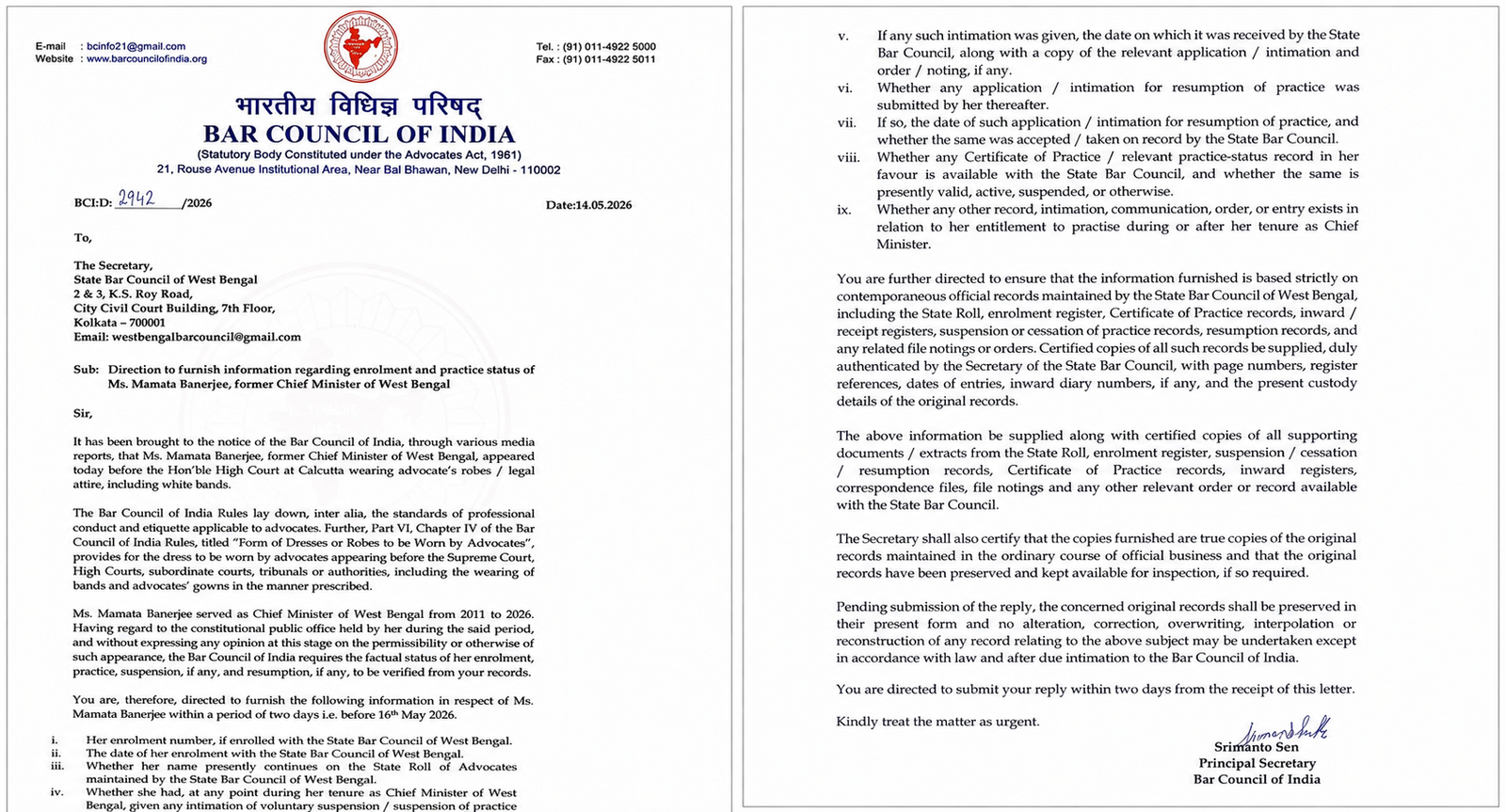
Acting on those media reports, the Bar Council of India (BCI) — the statutory apex body constituted under the Advocates Act, 1961 — has written a formal letter to the Secretary of the State Bar Council of West Bengal, directing it to furnish comprehensive records on Ms. Banerjee’s enrolment and practice status. The letter, bearing reference No. BCED: 2942/2026 and signed by Principal Secretary Srimanto Sen, was dispatched on 14 May 2026.
“The Bar Council of India requires the factual status of her enrolment, practice, suspension, if any, and resumption, if any, to be verified from your records.”
Nine Specific Questions, One Tight Deadline
The BCI’s letter is notably precise in its scope. It poses nine distinct questions to the State Bar Council, demanding information that spans the entirety of Ms. Banerjee’s association — or lack thereof — with formal legal practice:
- i.Her enrolment number, if enrolled with the State Bar Council of West Bengal.
- ii.The date of her enrolment with the State Bar Council.
- iii.Whether her name presently continues on theState Roll of Advocates.
- iv.Whether she gave any intimation of voluntary suspension or cessation of practice during her tenure as Chief Minister.
- v.If such intimation was given, the date it was received, along with copies of the relevant application and any order passed thereon.
- vi.Whether any application for resumption of practice was subsequently submitted.
- vii.The date and acceptance status of such a resumption application, if any.
- viii.Whether a validCertificate of Practiceis presently on record and whether it is active, suspended, or otherwise.
- ix.Any other record, order, or entry relating to her entitlement to practise during or after her tenure as Chief Minister.
The BCI has further directed that the reply be supported by certified copies of all documents — including extracts from the State Roll, enrolment register, suspension or cessation of practice records, inward registers, correspondence files, and any related file notings or orders — duly authenticated by the Secretary of the State Bar Council with page numbers, register references, and inward diary numbers.
The Rules That Govern Who May Wear the Robes
The legal architecture underpinning this inquiry is clear. The Advocates Act, 1961 establishes the Bar Council of India as the apex regulatory authority for the legal profession in India. Under this framework, only an advocate duly enrolled on the roll of a State Bar Council — and holding a valid Certificate of Practice — is permitted to appear before courts and wear the prescribed professional attire.
Part VI, Chapter IV of the Bar Council of India Rules, titled “Form of Dresses or Robes to be Worn by Advocates,” prescribes the dress code for advocates appearing before the Supreme Court, High Courts, subordinate courts, and tribunals. This includes the wearing of bands and advocates’ gowns in the manner prescribed. Wearing this attire without valid enrolment and an active certificate of practice would constitute a serious breach of professional norms.
The BCI’s concern acquires an additional dimension in light of constitutional conventions. Public office holders — particularly those serving as Chief Ministers — have historically been understood to place their professional practice in abeyance, even if there is no mandatory provision requiring formal suspension of enrolment under the Advocates Act.
Precedent, Professional Ethics, and Public Office
This inquiry goes beyond a procedural check on records. It raises a question of enduring importance: what are the professional obligations of an advocate who simultaneously holds high constitutional office? Ms. Banerjee served as Chief Minister of West Bengal from 2011 through 2026 — a period during which, the BCI notes, she held “the constitutional public office.”
The BCI has been careful to state that it is not expressing any opinion on the permissibility or otherwise of Ms. Banerjee’s appearance in court. Its stated purpose is strictly factual verification. Nevertheless, if the records reveal an absence of a valid certificate of practice or an undisclosed suspension, the implications for professional conduct standards could be significant.
The case also tests whether the institutional mechanisms of the legal profession — the enrolment register, the State Roll, the Certificate of Practice — are adequately maintained to address such exceptional circumstances, particularly when an advocate assumes the highest executive office in a state.
A Test of Institutional Rigour
The Bar Council of India’s action is measured but unambiguous. By formally writing to the State Bar Council of West Bengal and imposing a 48-hour deadline, BCI has signalled that the professional standards governing the legal profession apply irrespective of the stature of the person concerned. The outcome of this inquiry — and the completeness of the State Bar Council’s response — will determine whether the matter is closed as a records-verification exercise or escalates into a broader disciplinary inquiry.
For the legal community, the case offers an important reminder that the Advocates Act, 1961 and the Bar Council of India Rules are not mere formalities. The right to wear an advocate’s robes before an Indian court is a privilege earned through enrolment, maintained through a valid certificate of practice, and protected by a regulatory architecture that this inquiry has now placed squarely under the spotlight.
Chamberly Media will continue to track developments as the State Bar Council of West Bengal submits its response.